
Onboarding Checklist
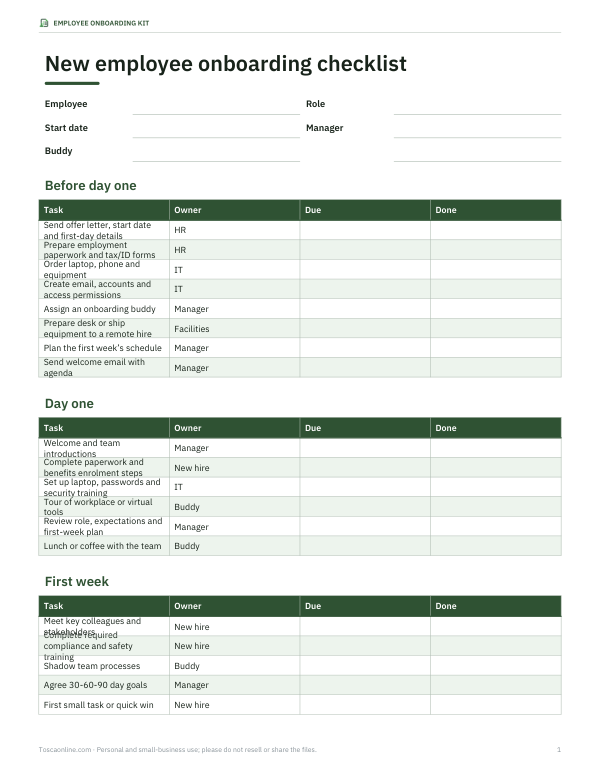
Good onboarding starts before day one and runs for about three months. This builder turns a start date into a dated checklist — who does what, and when — for HR, IT, the manager, the onboarding buddy and the new hire. Tick tasks off as you go, add your own, and print or export the plan.
- Free to use
- No sign-up
- Runs in your browser

Onboarding checklist builder
Employee Onboarding Kit
Editable onboarding checklist, onboarding tracker spreadsheet with working-day due dates, 30-60-90 day plan template, welcome email template and a new-hire feedback survey.
- Checklist (DOCX/PDF)
- Tracker (XLSX)
- 30-60-90 plan (DOCX/PDF)
- Welcome email (DOCX)
- Feedback survey (PDF/DOCX)
Formats: DOCX, PDF, XLSX. Instant download after payment (link valid 72 hours, up to 5 downloads). AI-assisted: the templates were drafted with AI help and reviewed and laid out before publishing.
$5.00 USD, one-time 5 files · about $1.00 each
- Instant download
- 7-day refund
- Secure checkout by Stripe
7-day money-back guarantee. Full refund within 7 days of purchase, even after you download.
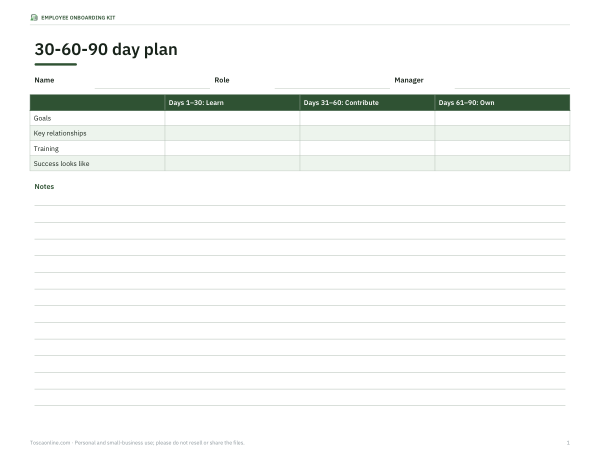
Free sample: 30 60 90 Day Plan (PDF, 52 KB)
Full refund within 7 days — see the refund policy and license.
Free printables
Single sheets you can print right now, no sign-up. The full pack adds every sheet in one download plus the editable files.
 Printable Welcome Email Template
 Printable New Hire Feedback Survey
The onboarding timeline
| Phase | Timing | Tasks | Focus |
|---|---|---|---|
| Before day one | 5 working days before | 8 | Send offer letter, start date and first-day details; Prepare employment paperwork and tax/ID forms |
| Day one | Start date | 6 | Welcome and team introductions; Complete paperwork and benefits enrolment steps |
| First week | 4 working days after start | 6 | Meet key colleagues and stakeholders; Complete required compliance and safety training |
| First 30 days | 20 working days after start | 5 | Weekly one-to-ones; Learn core tools and systems |
| Days 31–60 | 40 working days after start | 3 | Take ownership of first project; Build relationships across teams |
| Days 61–90 | 60 working days after start | 4 | Work independently on core responsibilities; Identify an improvement idea |
Due dates count working days (Monday to Friday) from the start date. Public holidays aren’t included — adjust dates in the printed plan or CSV if your organisation has closures.
Who does what
| Owner | Typical responsibilities |
|---|---|
| HR | Offer, paperwork, benefits information, policies, surveys |
| IT | Equipment, accounts, access, security training |
| Manager | Welcome, goals, schedule, regular check-ins, reviews |
| Buddy | Informal questions, tours, introductions, team habits |
| Facilities | Desk, badge, parking or shipping equipment |
| New hire | Training, meeting colleagues, early contributions |
Filter the list by owner to give each person just their tasks.
Worked example
Jordan Rivera starts as a marketing coordinator on a Monday in a hybrid team. The builder dates pre-boarding tasks five working days earlier — the previous Monday — so IT orders the laptop and the manager assigns a buddy in good time. Day-one tasks fall on the start date, first-week goals on the Friday, and the 30-, 60- and 90-day check-ins 20, 40 and 60 working days later. The manager adds two custom tasks, filters the view to “IT” to send the IT team their list, and prints the full plan for Jordan’s first meeting.
Remote and frontline onboarding
- Remote: ship equipment early, confirm it arrives, and schedule short video check-ins through the first week.
- Remote: pair the new hire with a buddy in a similar time zone.
- Frontline: schedule safety induction and shadow shifts before independent work.
- Frontline: make sure uniforms, badges and scheduling apps are ready on day one.
- All: provide a single page listing who to ask for what.
Why the first 90 days matter
Employers commonly find that the first weeks shape whether a new hire feels welcomed, understands expectations and becomes productive. Structured onboarding — a clear plan, a named buddy and regular check-ins — gives new starters early wins and surfaces problems while they are easy to fix. The 30-60-90-day rhythm in this checklist is a widely used structure; adapt it to your organisation’s probation or introductory period.
Common onboarding mistakes
- Equipment and accounts not ready on day one, so the first days are wasted.
- Information overload in the first week — spread training out.
- No clear first-week goals, leaving new hires unsure what success looks like.
- Check-ins that stop after the first week.
- No buddy or informal support, making it hard to ask “small” questions.
- Onboarding treated as HR’s job alone rather than shared by the manager and team.
Tips for the manager
Block time in your calendar for the new hire’s first week before they arrive — a manager who is unavailable on day one sends the wrong message. Share the plan in advance, introduce the new hire personally to the people they will work with most, and agree one or two concrete goals for the first month. Ask open questions at each check-in: what is going well, what is confusing, and what would help. Small signals — a name on the door, a welcome message in the team channel, lunch on the first day — make a big difference to how welcome people feel.
Measuring onboarding
| Measure | How to collect it |
|---|---|
| Day-one readiness | Did equipment and access work on the first morning? (yes/no) |
| Time to first contribution | Date of first completed task or project |
| New-hire satisfaction | Short survey at 30 and 90 days |
| Manager check-ins held | Count of scheduled vs held one-to-ones |
| Early retention | Whether new hires are still with you after their introductory period |
Review the results after every few hires and adjust the checklist — onboarding improves most when it is treated as a process to refine rather than a one-off event.
Compliance reminders
Paperwork requirements differ by country and state — for example tax forms, right-to-work checks and mandatory training. The checklist includes placeholders for these steps but doesn’t list jurisdiction-specific forms; check with HR or an employment advisor for your location.
What’s in the template pack
- Editable onboarding checklist (Word and PDF)
- Onboarding tracker spreadsheet with automatic working-day due dates
- 30-60-90 day plan template
- Welcome email template
- New-hire feedback survey
The builder is free; the pack is a one-time download.
Privacy
Names and tasks stay in your browser.
Frequently asked questions
What should an onboarding checklist include?
Pre-boarding, day one, first week and 30/60/90-day tasks with clear owners and dates.
How long should onboarding last?
Many organisations plan for about 90 days, sometimes longer for complex roles.
What is pre-boarding?
Everything done between offer acceptance and day one: paperwork, equipment and a welcome.
What does an onboarding buddy do?
Answers everyday questions and helps the new hire meet people.
Does it skip weekends?
Yes — due dates count working days Monday to Friday.
Is my data saved?
No. Print or download the CSV to keep it.
Can I add my own tasks?
Yes — add lines like “week1 | Meet the sales team | New hire”.
What is the difference between onboarding and orientation?
Orientation is usually a single session about the organisation; onboarding is the whole process over the first months.